III. Vibhūti Pāda · Inner maps (3.25–3.34)
3.25 · The Searching Beam
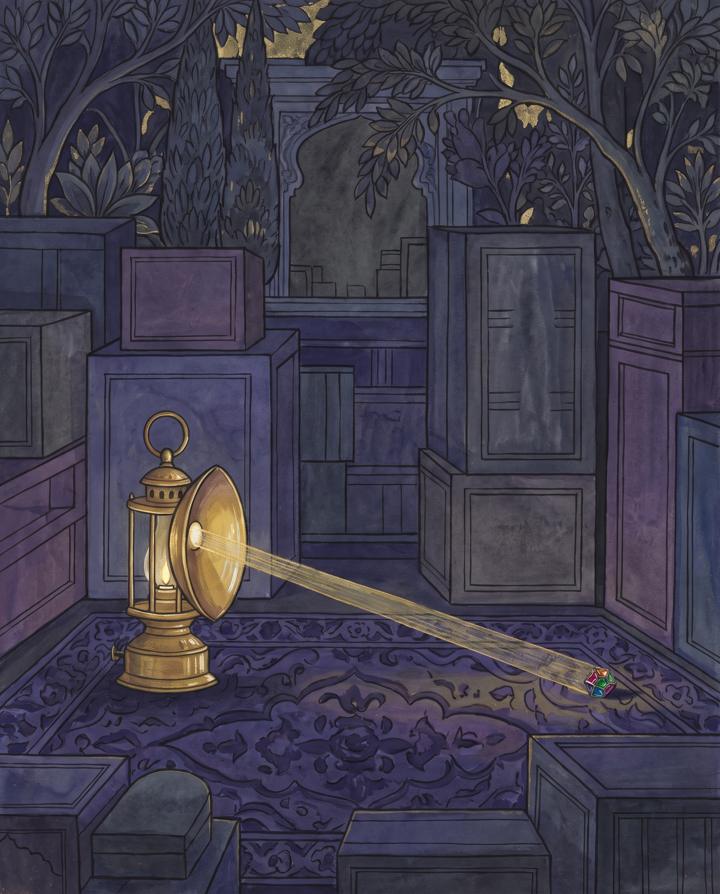
By directing the light of the luminous inner activity comes knowledge of the subtle, the hidden and the distant.
Word by word
- pravṛtti
- activity (of the luminous mind)
- āloka
- light
- nyāsāt
- from directing, casting
- sūkṣma
- subtle
- vyavahita
- hidden, screened
- viprakṛṣṭa
- distant
- jñānam
- knowledge
Where it fits
A second run begins with the mind's inner light. Vyāsa identifies it with the luminous activity of 1.36 (p. 253): cast on its object, it reveals the subtle, the hidden and the distant. The next sūtras direct saṃyama to particular lights and places, from the sun (3.26) to the heart (3.34).
Reading
A second run of powers begins with the mind's own light. Vyāsa says this light is the luminous activity described in 1.36, the state that is luminous and free of sorrow, cast on its object like a beam. Patañjali states this as a power, and its image is plain: attention as a lamp you can point. The sūtras that follow direct that lamp to the sun, the moon, the stars and the body. One way to read this today: much of what we miss is not invisible. It is simply unlit.
Vyāsa
“The luminous activity of the mind has been described (1.36). The yogi casts its light on an object that is subtle, hidden or distant, and so reaches that object.”
Vyāsa's Yoga-bhāṣya, the oldest commentary. New translation from the Sanskrit, with reference to Woods (1914), p. 253.
Practice
Choose a familiar place, your desk or a corner of a room. Spend five minutes looking at it as if with a narrow lamp, one small patch at a time. List three things you had never noticed before.
A question to sit with
What is here that you have never lit up?