III. Vibhūti Pāda · Inner maps (3.25–3.34)
3.26 · The Sun's Doorway
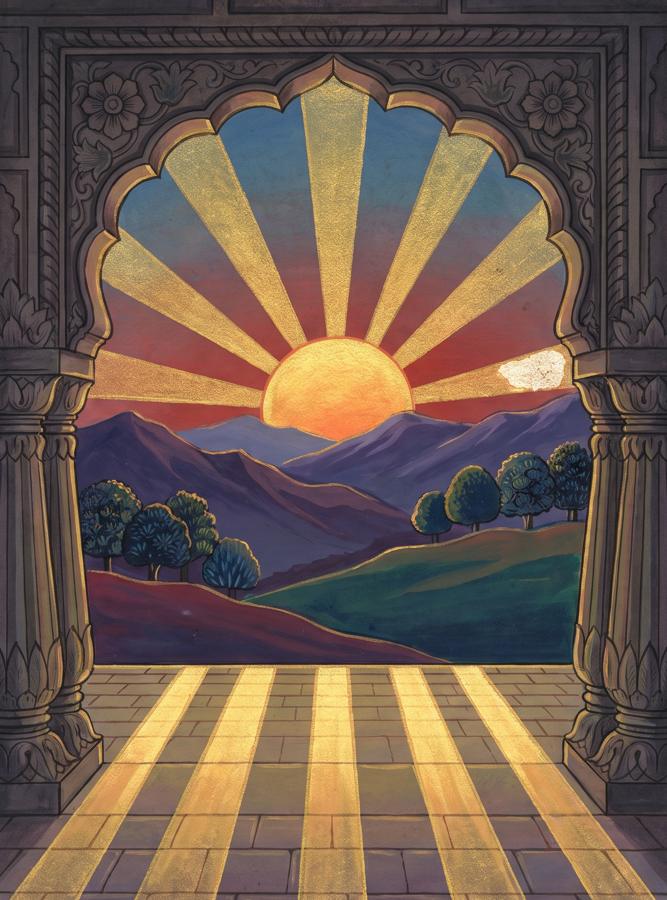
Saṃyama on the sun gives knowledge of the worlds.
Word by word
- bhuvana-jñānam
- knowledge of the worlds
- sūrye
- on the sun
- saṃyamāt
- from saṃyama
Where it fits
The first such place is the sun, which gives knowledge of the worlds. Vyāsa follows with a full Purāṇic cosmology of seven worlds and their hells, to be seen directly by saṃyama on 'the door of the sun' (p. 257). 3.27–3.28 complete the sky with the moon and the pole star.
Reading
The lamp of 3.25 is turned first on the sun. Vyāsa follows with the longest comment in the pāda, a whole cosmology: seven worlds in tiers, hells below, Mount Sumeru at the centre, ring-shaped seas of milk and sugar-cane juice. The universe itself, he says, is a speck of nature, 'like a firefly in the sky'. This is the Purāṇic map of its time, not modern astronomy. Vācaspati reads Vyāsa's 'door of the sun' as a channel in the body, so some take the sun here as an inner point.
Vyāsa
“All of this, firmly founded in its arrangement, is laid out in the middle of the [World] Egg. And the Egg is a tiny particle of nature, like a firefly in the sky.”
Vyāsa's Yoga-bhāṣya, the oldest commentary. New translation from the Sanskrit, with reference to Woods (1914), p. 255.
Practice
At sunrise or sunset, never looking straight at the sun, watch its light move across a wall, a field or a street for ten minutes. Then consider how much of the world that one light is reaching today.
A question to sit with
How large is the world you can see?
Where commentators disagree
Is 'the sun' of 3.26 the sun in the sky or a point in the subtle body?
- Vyāsa
- After describing the seven worlds he says the yogin should perceive all this by saṃyama on 'the door of the sun', and then on other objects too, until all is seen. (Woods 1914, p. 257)
- Vācaspati Miśra
- Explains 'the door of the sun' as the channel called suṣumnā, an inner reading. (Woods 1914, p. 259)
- Bhoja
- Saṃyama is on the luminous, visible sun. He contrasts it with 3.25, whose light is that of the mind's sattva, while here the light is material. (Tatya 1885, p. 117; Mitra 1883, wisdomlib on 3.26)
- J. H. Woods
- Suggests that 'the door of the sun' is the entrance to the world of Brahmā, comparing the Maitri, Muṇḍaka and Chāndogya Upaniṣads. (Woods 1914, p. 257, n. 2)