I. Samādhi Pāda · Ways to a clear mind (1.33–1.39)
1.36 · The Waveless Sea
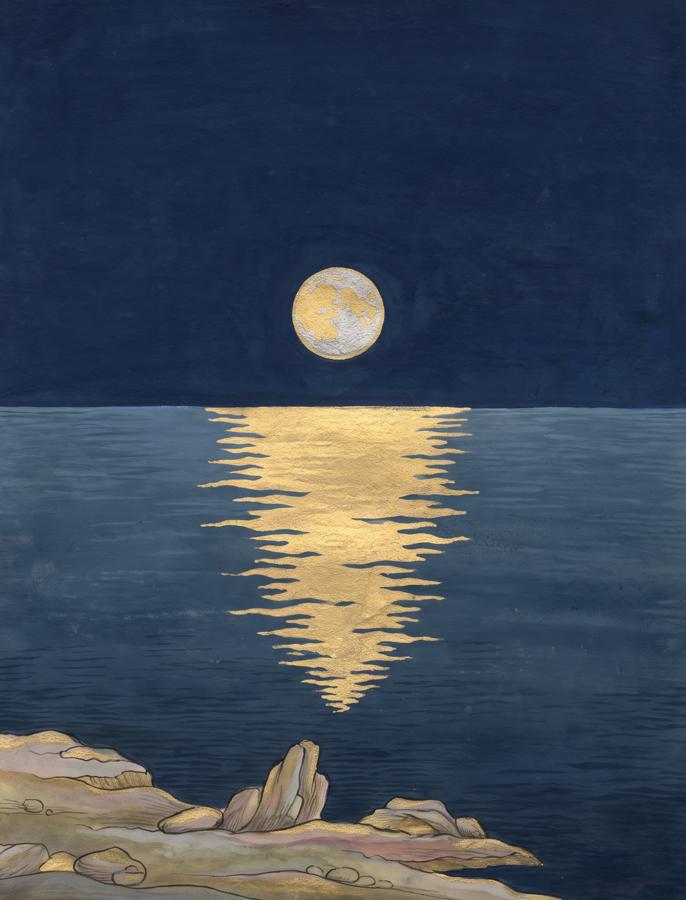
Or a state that is luminous and free of sorrow.
Word by word
- viśokā
- free of sorrow
- vā
- or
- jyotiṣmatī
- luminous, full of light
Where it fits
The supports move inward, from the senses (1.35) to a luminous state of mind. Vyāsa describes two forms, one with an object and one that is the bare sense 'I am' (Woods p. 74). This anticipates the stage of 'I am' in 1.17 and the coalescence defined in 1.41.
Reading
The supports now move inward, from the senses of 1.35 to a state of mind. Vyāsa places it at the lotus of the heart: attending there, the mind becomes radiant like the sun, moon, planets or gems, and pervasive like space. Resting in the bare sense 'I am', it becomes, in his words, like a great ocean without waves, peaceful, boundless. Later commentators, Vācaspati among them, drew detailed maps of this heart-lotus. The sūtra itself is short and simple: some find steadiness by turning toward an inner light.
Vyāsa
“It is the awareness of the intellect that comes to one who concentrates on the lotus of the heart. … In the same way the mind, coalesced with I-am-ness, becomes like a great ocean without waves, peaceful, boundless …”
Vyāsa's Yoga-bhāṣya, the oldest commentary. New translation from the Sanskrit, with reference to Woods (1914), p. 74.
Practice
Sit and rest attention in the centre of the chest for five minutes. Imagine a soft light there, the colour of moonlight, and let it widen gently with each breath. If no light appears, rest in the quiet sense of simply being here.
A question to sit with
Where is the light in you today?
Where commentators disagree
What is the 'luminous, sorrowless' state of 1.36, and how much of the subtle body does it assume?
- Vyāsa
- It is the awareness that arises when one fixes attention on the lotus of the heart: the mind becomes radiant like space, like the sun, moon, planets or gems, and, resting on the sense of 'I am' alone, becomes waveless like the great sea. (Woods 1914, p. 74)
- Vācaspati Miśra
- Gives a full map: the eight-petalled heart lotus faces downwards and is turned upwards by breathing out; within it lie circles of sun, moon and fire with the letters A, U and M, and the channel suṣumnā, on which the mind is fixed. (Woods 1914, p. 75)
- Bhoja
- The light is the sattva of the mind. When the mind rests in it in the cup of the heart lotus, like the milky ocean without waves, the restless functions fade and steadiness follows. (Tatya 1885, p. 33; Mitra 1883, wisdomlib on 1.36)