I. Samādhi Pāda · Coalescence (1.40–1.46)
1.41 · The Flawless Jewel
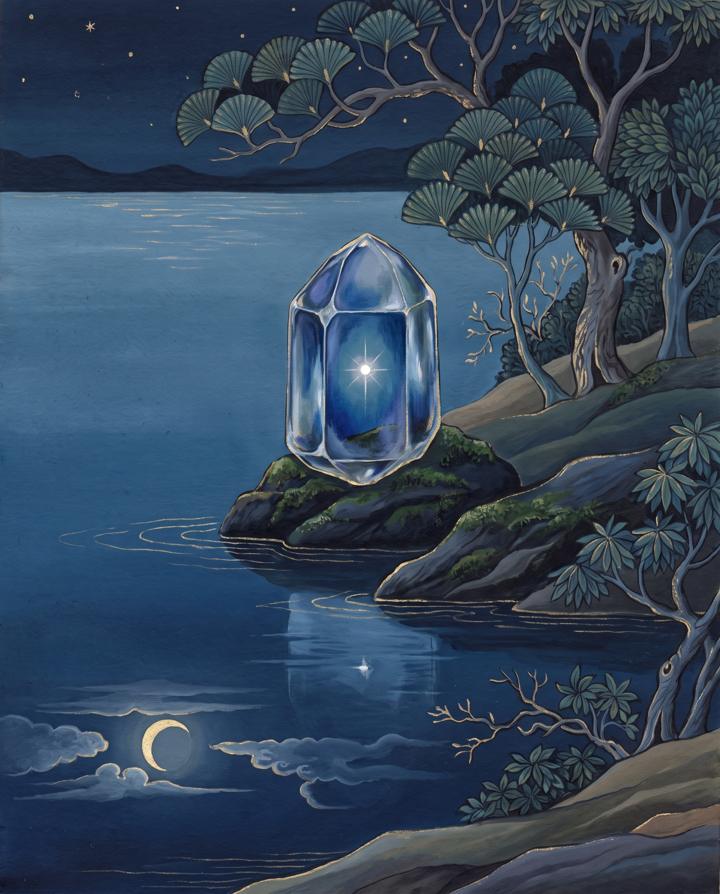
When its movements have faded, the mind is like a clear jewel, taking on the colour of whatever it rests on: knower, knowing or known. This is coalescence.
Word by word
- kṣīṇa-vṛtteḥ
- of the mind whose movements have faded
- abhijātasya
- well-born, flawless
- iva
- like
- maṇeḥ
- of a jewel
- grahītṛ
- the knower
- grahaṇa
- the knowing
- grāhyeṣu
- and the known
- tat-stha
- resting on that
- tad-añjanatā
- taking on its colour
- samāpattiḥ
- coalescence
Where it fits
Vyāsa asks the question this passage answers: for a mind that has gained steadiness (1.40), what is coalescence, and what are its objects? (Woods p. 77). The clear jewel defines samāpatti, the term that structures 1.42–1.47 and fills out the stages of absorption named in 1.17.
Reading
Here is the central image of the pāda, and it is in the sūtra itself: a flawless jewel. When the mind's movements have faded, it is like clear crystal, taking the colour of whatever lies near it. Vyāsa spells it out: as a crystal is tinged by what lies beside it, the still mind takes the form of its object, whether a thing known, the act of knowing, or the knower. This is samāpatti, coalescence. The familiar red flower beside the crystal is Vācaspati's. 1.42–1.44 describe the kinds.
Vyāsa
“Just as a crystal, coloured by the different things that lie beside it, shines with the form of the thing beside it, so the mind, coloured by the known object it rests on, … shines with the form of that object as it is in itself.”
Vyāsa's Yoga-bhāṣya, the oldest commentary. New translation from the Sanskrit, with reference to Woods (1914), p. 78.
Practice
Choose a simple object and look at it for five minutes. Each time you notice yourself judging, naming or thinking about it, let that fade and go back to simply receiving it, the way clear glass receives colour.
A question to sit with
What colour is your mind taking on?