I. Samādhi Pāda · Truth-bearing wisdom (1.47–1.51)
1.47 · The High Crag
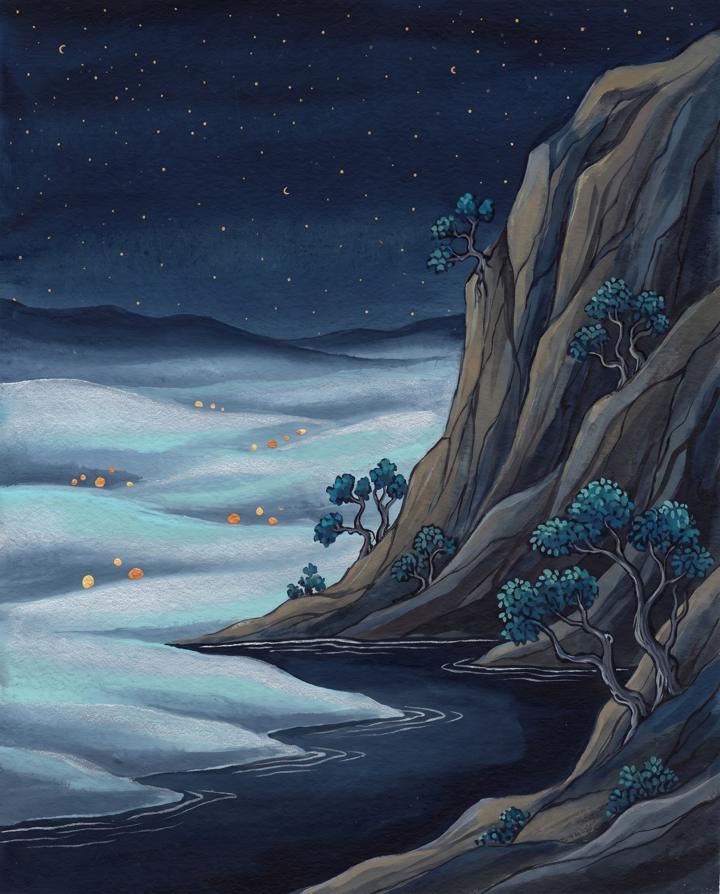
In the clarity of 'beyond subtle thought', inner serenity arises.
Word by word
- nirvicāra
- beyond subtle thought
- vaiśāradye
- in the clarity, the mastery
- adhyātma
- inward, pertaining to oneself
- prasādaḥ
- serenity, clearness
Where it fits
Of the four coalescences (1.42–1.44), the last, 'beyond subtle thought', is where clarity arises. This begins a chain of fruits: serenity here, truth-bearing wisdom in 1.48, its own kind of object in 1.49, its impression in 1.50. Vyāsa marks the height with a verse about a sage on a mountain (Woods p. 93).
Reading
Of the four coalescences, it is the last and finest, nirvicāra, that ripens into inner serenity. Vyāsa places this clarity in the mind's sattva, its lightness, whose light flows in a steady, transparent stream; the self itself does not change. The seeing takes in things as they are, all at once. Then he quotes a verse: as one standing on a mountain looks down on those on the plain, so the wise one, beyond grief, looks down on all who grieve. The view is clear, and what it sees clearly is others' suffering.
Vyāsa
“… then the yogi gains inner serenity … As it has been said: 'Having climbed to the serenity of wisdom, the wise one, beyond grief, looks down on all who grieve, as one standing on a mountain looks down on those on the plain.'”
Vyāsa's Yoga-bhāṣya, the oldest commentary. New translation from the Sanskrit, with reference to Woods (1914), p. 93.
Practice
Go somewhere high today that is safe to reach, a staircase, a hill or an upper window, and look out for two minutes. Notice how small troubles look from height. Then bring to mind one person who is struggling and hold them in that clear, unhurried view.
A question to sit with
From your clearest place, what do you see?