III. Vibhūti Pāda · Knowledge through saṃyama (3.16–3.24)
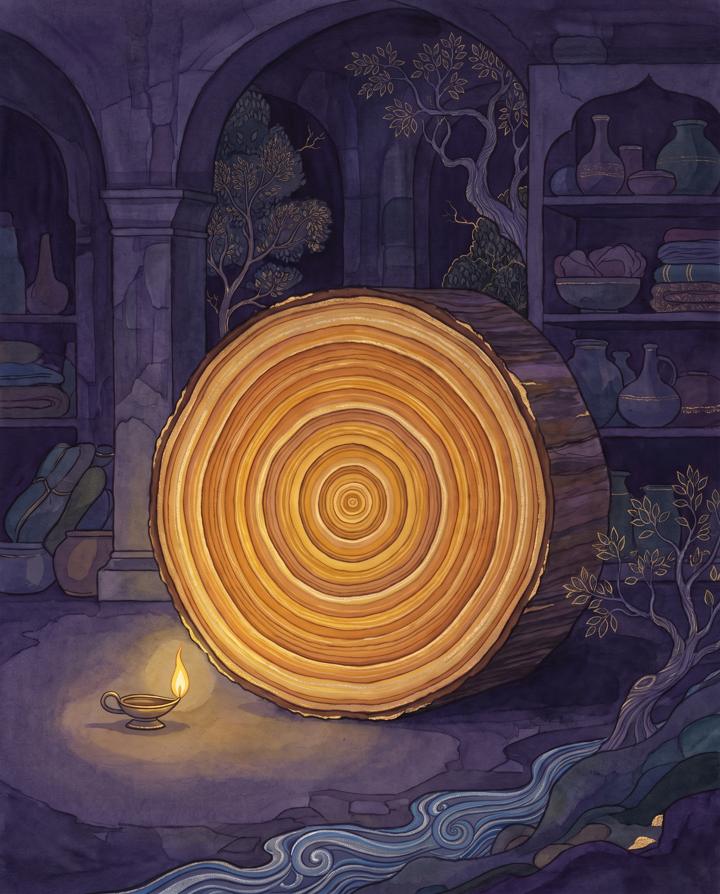
3.18 · Rings of the Teak
By directly perceiving latent impressions comes knowledge of former births.
Word by word
- saṃskāra
- latent impressions
- sākṣāt-karaṇāt
- from perceiving directly
- pūrva-jāti
- former births
- jñānam
- knowledge
Where it fits
Saṃyama turns to the latent impressions of 2.12–2.13 and 3.9. Seeing them directly reveals former births. In Vyāsa's story, Jaigīṣavya's vision ends not in curiosity but in the knowledge born of discernment (p. 247), which anticipates 3.52, and in the verdict of 2.15 that all is suffering.
Reading
Saṃyama now turns to the latent impressions, saṃskāra, that experience leaves behind. The tradition takes rebirth as given, with impressions carried from life to life (2.12–2.13). Vyāsa tells of the sage Jaigīṣavya, who saw his births through ten great world-cycles and concluded that whatever pleasure he had passed through was nothing but pain. In the story the vision serves discrimination, not curiosity. One way to read this today: within one life, the same attention can trace a present reaction back to the impressions that formed it.
Vyāsa
“The revered Jaigīṣavya, by directly perceiving his latent impressions, watched the succession of his births through ten great cycles of creation, and the knowledge born of discernment arose in him. … 'Whatever I have lived through, I know all of it to be nothing but suffering.'”
Vyāsa's Yoga-bhāṣya, the oldest commentary. New translation from the Sanskrit, with reference to Woods (1914), p. 247–248.
Practice
Notice one strong automatic reaction today: flinching at criticism, reaching for food when tired. Sit quietly and ask, 'When did I first learn this?' Follow it back as far as memory goes, gently, without forcing. Write down what you find.
A question to sit with
How old is this reaction?
Key ideas
saṃskāra (latent impressions), karma (action and its residue), saṃyama (holding together), siddhi (powers)