III. Vibhūti Pāda · Transformations (3.9–3.15)
3.13 · One Gold, Many Shapes
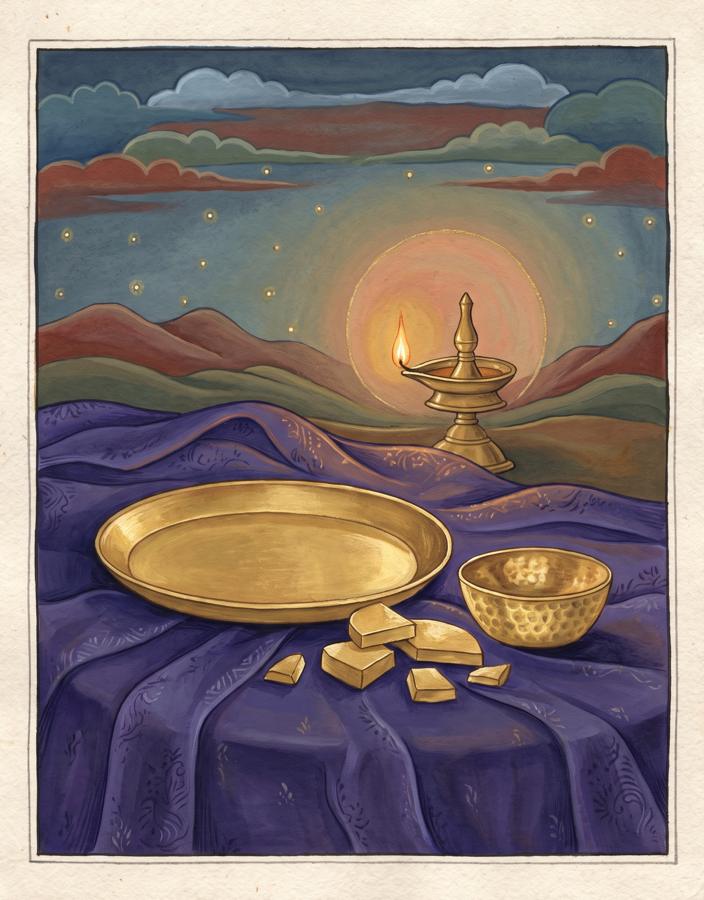
This explains the transformations of quality, time and condition in the elements and the senses.
Word by word
- etena
- by this
- bhūta-indriyeṣu
- in the elements and the senses
- dharma
- quality, form
- lakṣaṇa
- time-mark: past, present or future
- avasthā
- condition, state
- pariṇāmāḥ
- transformations
- vyākhyātāḥ
- are explained
Where it fits
Vyāsa reads 'by this' as 'by the change of mind just described' (p. 212). The same analysis now covers the elements and senses, which 2.18 says make up the seen. Change of quality, of time and of condition is the map that saṃyama on the transformations will use at 3.16.
Reading
The changes just described in the mind apply to everything, the elements and the senses alike. A thing changes in form (a lump of clay becomes a jar), in time (the jar is future, then present, then past) and in condition (new, then old). Vyāsa's examples: one stroke counts as one, ten or a hundred by its place, and one woman is mother, daughter and sister. Strictly, he adds, there is one change: the substance stays while its forms come and go, as gold stays gold when a plate is reshaped.
Vyāsa
“Of these, the qualities that have taken on a time-form, as they reach one condition or another, are spoken of as different: different in condition, not in substance. So a single stroke stands for a hundred in the hundreds' place, ten in the tens' place, and one in the units' place. So too one woman is called a mother, a daughter and a sister.”
Vyāsa's Yoga-bhāṣya, the oldest commentary. New translation from the Sanskrit, with reference to Woods (1914), p. 215–216.
Practice
Pick up one thing you own, a cup or a ring. Name its form now and what it was before, whether it is new or worn, and how long it has been in your life. Then name the material that has stayed the same throughout.
A question to sit with
What stays the same while everything about it changes?
Where commentators disagree
Is Yoga's account of change in 3.13 its own, and where do Vyāsa's examples come from?
- Vyāsa
- The three times belong to a thing's outer aspects, not to its substance. The same stroke is called one in the units' place, ten in the tens' place and a hundred in the hundreds' place; the same woman is called mother, daughter and sister. Clay becomes a lump, then a jar, and the jar ages moment by moment. (Woods 1914, pp. 215–216)
- Bhoja
- Gives only the clay: it gives up the form of a lump for that of a jar (change of property), the jar passes from future to present to past (change of time), and its state never stays the same even for a moment. (Tatya 1885, pp. 103–104; Mitra 1883, wisdomlib on 3.13)
- J. H. Woods
- Treats the stroke example as decimal place-value notation; since the oldest dated inscription using it is from AD 595, he judged the Comment unlikely to be earlier than about AD 500. (Woods 1914, pp. xx–xxi; p. 216, n. 1)
- Dominik Wujastyk
- Following Maas, shows that the passage reworks Buddhist arguments reported by Vasubandhu (Abhidharmakośabhāṣya 5.25–26): the gold vessel wording, Buddhadeva's woman who is mother, daughter and sister, and Vasumitra's counter that says one, a hundred or a thousand by its place. He dates Patañjali's version to about 375–425. (Wujastyk 2018, pp. 39–41)