III. Vibhūti Pāda · Saṃyama (3.1–3.8)
3.6 · The Lamplit Stair
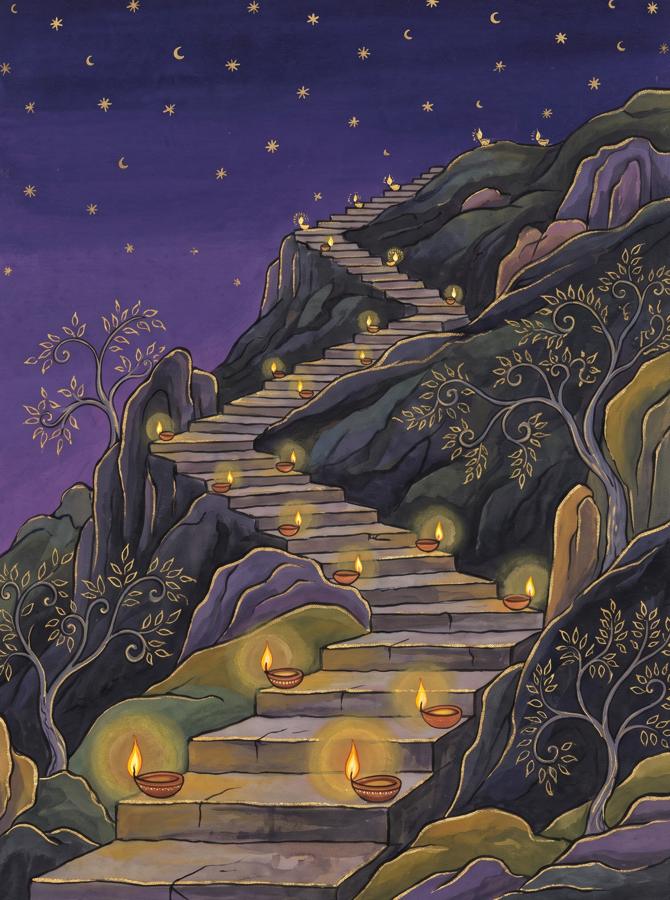
It is applied in stages.
Word by word
- tasya
- its
- bhūmiṣu
- in stages, on its levels
- viniyogaḥ
- application
Where it fits
How is saṃyama used? In stages, each mastered before the next. Vyāsa says no stage can be skipped, and yoga itself is the only teacher of which comes next (p. 206). He names knowing another's mind (3.19) as a lower stage, so the objects listed from 3.16 on are stages of practice.
Reading
Vyāsa is blunt about the order of practice: whoever leaps over the next stage without mastering the one below does not gain the higher. How do you know which stage is next? Yoga itself is the only guide, he says, and quotes a verse: by yoga, yoga must be known. Practice shows you where you are. So the long list of objects later in this pāda is a sequence, not a menu. The same patience runs through the stages of coalescence in 1.42–1.44 and the slow thinning of 2.2.
Vyāsa
“This saṃyama is applied to the stage that comes right after the one already mastered. For someone who has not mastered the lower stage cannot leap over the next one and gain saṃyama in the farthest stages. … As to which stage comes next after which, yoga itself is the only teacher.”
Vyāsa's Yoga-bhāṣya, the oldest commentary. New translation from the Sanskrit, with reference to Woods (1914), p. 206.
Practice
Name one thing you practise: sitting, an instrument, a language. Write down the stage you have honestly mastered and the very next stage, only one step up. Spend ten minutes today on that next step and nothing beyond it.
A question to sit with
What is your actual next step?
Where commentators disagree
Must saṃyama climb every stage in order, or can a stage be given?
- Vyāsa
- Saṃyama is applied to the stage next above the one already mastered; whoever leaps a stage does not gain the higher. But one who has reached a higher stage by the grace of Īśvara need not practise saṃyama on the lower ones. Yoga itself is the only guide to which stage comes next. (Woods 1914, p. 206)
- Vācaspati Miśra
- Takes the stages as the coalescences of 1.42–1.44 in order, coarse before subtle, illustrated by a Purāṇic meditation in which Viṣṇu's weapons and ornaments are removed one by one. The skipped stage is explained as already obtained from devotion to Īśvara. (Woods 1914, p. 207)
- Bhoja
- The stages run from coarse to subtle objects; the higher is practised only after the lower is mastered, because the fruit does not come otherwise. He states the rule without mentioning any exception by grace. (Tatya 1885, p. 97; Mitra 1883, wisdomlib on 3.6)