III. Vibhūti Pāda · Saṃyama (3.1–3.8)
3.3 · Only the Flame
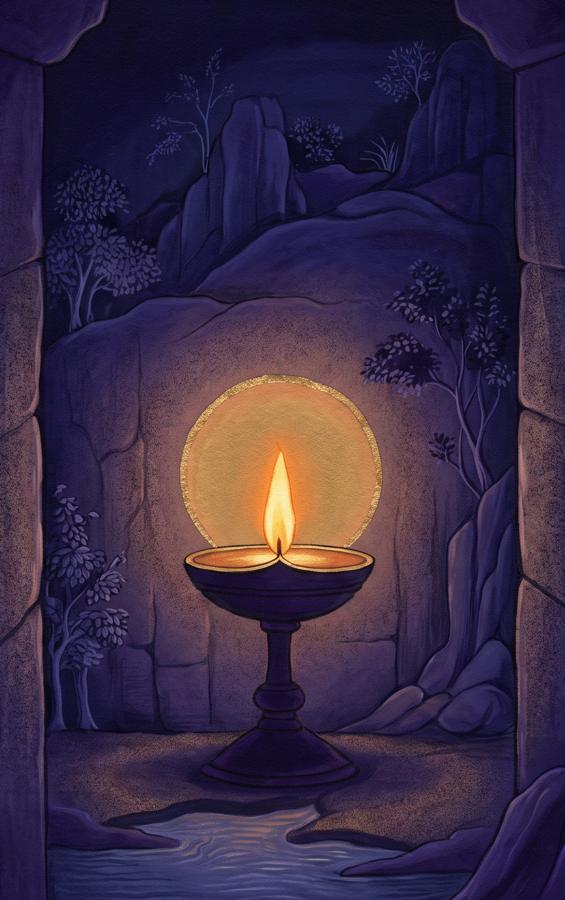
Absorption is that same meditation when only the object shines, as if empty of its own form.
Word by word
- tad
- that
- eva
- same
- artha-mātra-nirbhāsam
- shining as the object alone
- sva-rūpa-śūnyam
- empty of its own form
- iva
- as if
- samādhiḥ
- absorption
Where it fits
The third inner limb completes the series. Absorption is 'that same' meditation of 3.2, now so given to its object that it seems empty of itself. The wording repeats 1.43, so this is the coalescence of pāda 1 reached through the limbs. 3.4 names the three together.
Reading
Absorption is the same meditation carried further. Only the object shines, and the one meditating seems to vanish into it. Patañjali says 'as if' empty of its own form: the act of meditating drops out of view and only the object appears. Vyāsa says the meditation enters into the nature of its object. One way to read this today: anyone lost in music or in good work has touched the edge of it. The wording repeats 1.43, where coalescence is described the same way.
Vyāsa
“When meditation shines forth only in the form of its object, and becomes as if empty of its own nature as a thought, because it has entered into the nature of the object, it is called absorption.”
Vyāsa's Yoga-bhāṣya, the oldest commentary. New translation from the Sanskrit, with reference to Woods (1914), p. 204–205.
Practice
Choose something simple and absorbing: listening to one piece of music, watching water, drawing a leaf. Give it ten minutes. Afterwards, recall the moments when you forgot yourself. What was left when the sense of 'I am doing this' dropped away?
A question to sit with
When did you last forget yourself in what you were attending to?
Where commentators disagree
What marks the shift from contemplation (dhyāna) to absorption (samādhi), and is samādhi a 'trance'?
- Vyāsa
- When contemplation shines forth as the object alone and is, as it were, empty of its own form as an idea, entering into the nature of the object, it is called absorption. (Woods 1914, pp. 204–205)
- Vācaspati Miśra
- 'As it were' answers the objection that if it were empty the object could not appear. What drops away is the distinction (kalpanā) between the contemplating and the thing contemplated; he cites the Viṣṇu Purāṇa for this. (Woods 1914, p. 205)
- Bhoja
- When only the one object is lit up and the thought seems to lose its own identity, that is samādhi; the word means that which brings the mind together, setting it on one point by avoiding all distractions. (Tatya 1885, pp. 95–96; Mitra 1883, wisdomlib on 3.3)
- Rajendralala Mitra
- In samādhi even the distinction between thinker and thought is lost. 'Trance' or 'catalepsy' is a poor English word for it, since it notes only the stopping of bodily functions, while samādhi stresses the intensity of thinking. (Mitra 1883, note on 3.3 (wisdomlib))
Key ideas
samādhi (absorption), saṃyama (holding together), samāpatti (coalescence)