I. Samādhi Pāda · Coalescence (1.40–1.46)
1.43 · The Jar Alone
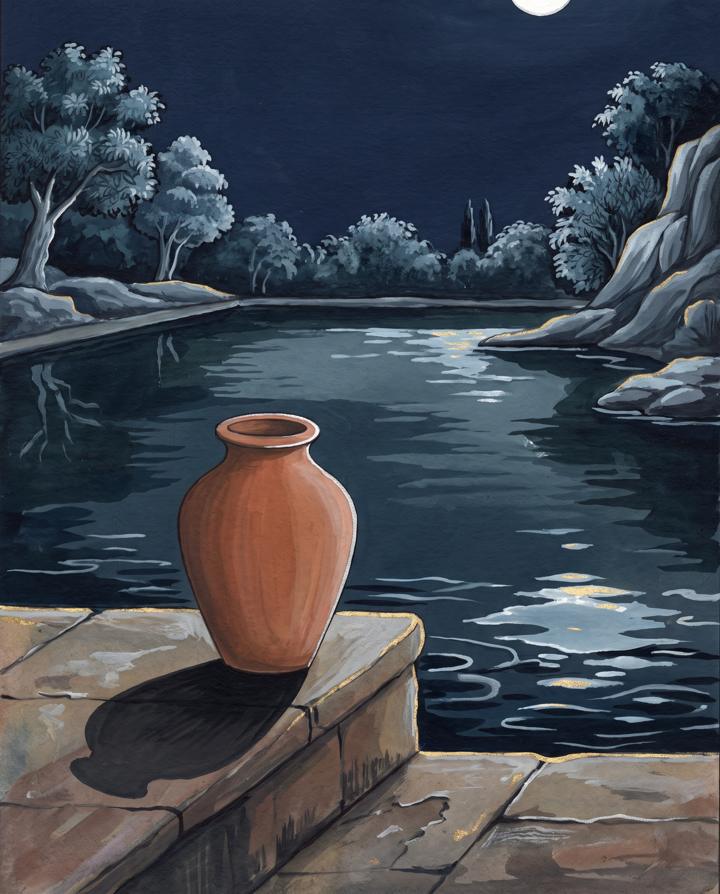
When memory is purified, the coalescence seems empty of its own form and only the object shines: this is 'beyond coarse thought'.
Word by word
- smṛti-pariśuddhau
- when memory is purified
- svarūpa-śūnyā
- empty of its own form (said of the coalescence)
- iva
- as if
- artha-mātra-nirbhāsā
- with only the object shining
- nirvitarkā
- beyond coarse thought
Where it fits
The step after 1.42: when memory is purified, the object alone shines. Vyāsa first argues that this direct seeing is the seed of testimony and inference, a point 1.49 develops, then says the sūtra gives its mark (Woods p. 82). 3.3 reuses the phrase to define absorption.
Reading
When memory is cleared of the habit of names, the screen of 1.42 falls. The coalescence seems empty of its own form, and only the object shines. Vyāsa says the insight, as if setting aside its own form as knowing, becomes the object itself and nothing more. Note the 'as if'. The knowing does not vanish; it stops showing itself. In the passage that leads from 1.42 into this sūtra, Vyāsa calls such direct seeing the seed from which testimony and inference grow. The same phrase returns in 3.3 to describe samādhi.
Vyāsa
“Insight that … is coloured by the true form of the object, and that, as if setting aside its own form as insight, whose nature is grasping, becomes the object itself and nothing more … that is coalescence 'beyond coarse thought'.”
Vyāsa's Yoga-bhāṣya, the oldest commentary. New translation from the Sanskrit, with reference to Woods (1914), p. 82.
Practice
Look at a clay pot, a stone or a leaf for five minutes without naming it. When a word or memory arises, let it pass and return to colour, shape and texture. Notice any moment when only the thing seems to be there.
A question to sit with
What would you see if you forgot its name?
Key ideas
samāpatti (coalescence)