III. Vibhūti Pāda · Knowledge through saṃyama (3.16–3.24)
3.21 · The Unlit Corner
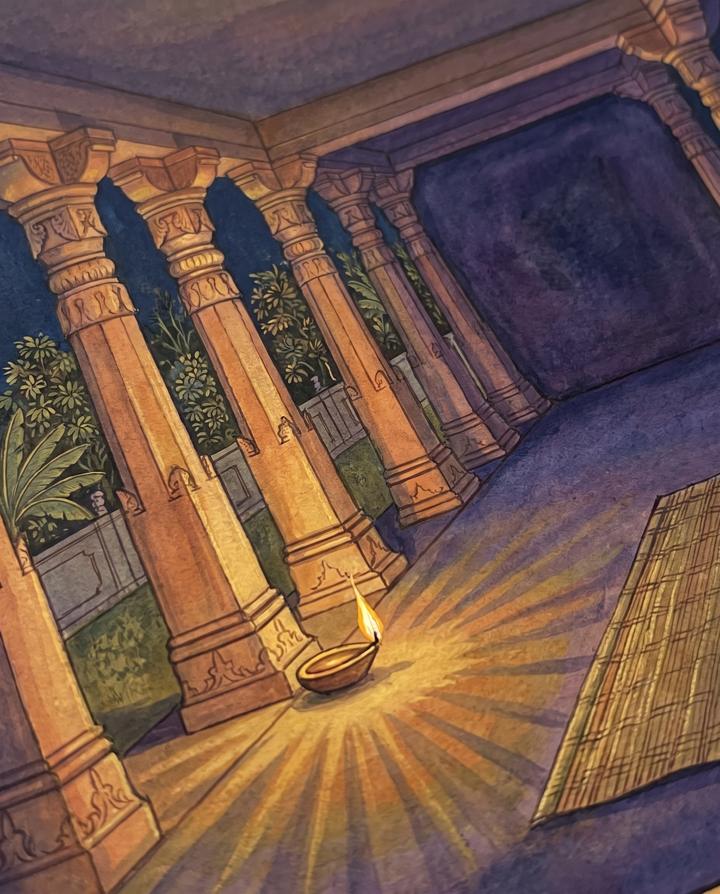
Saṃyama on the form of the body suspends its power to be seen; with no contact between light and eye, one becomes invisible.
Word by word
- kāya
- body
- rūpa
- form, visible appearance
- saṃyamāt
- from saṃyama on
- tad
- its
- grāhya-śakti
- power to be perceived
- stambhe
- when suspended
- cakṣuḥ
- eye
- prakāśa
- light
- asaṃprayoge
- when there is no contact
- antardhānam
- disappearance, invisibility
Where it fits
After knowing others comes not being seen. Saṃyama on the body's visible form suspends its power to be seen. Vyāsa adds that the same holds for sound and the other senses (p. 250), a line some editions print as a separate sūtra. 3.22 turns from the body to its end.
Reading
After knowing others' minds comes not being seen by them. Vyāsa explains the claim as a literal power and adds that vanishing to sound and the other senses works the same way. Some editions print that line as a separate sūtra. An ordinary analogy, not the same thing: the person so quiet that they pass unnoticed, set against the vanity that always wants to be seen. 3.37, read broadly, keeps every such power in its place.
Vyāsa
“… [The yogi] suspends the power of the body's form to be seen. When that power is suspended … the yogi disappears from view. In the same way, disappearing from hearing and the other senses should be understood as explained.”
Vyāsa's Yoga-bhāṣya, the oldest commentary. New translation from the Sanskrit, with reference to Woods (1914), p. 250.
Practice
In one group setting today, practise not needing to be seen. Speak only when it helps, let someone else take the credit, and notice the pull to be noticed. Ask where the wish to be visible comes from.
A question to sit with
How much of you needs to be seen?
Where commentators disagree
Is the line 'by this, the vanishing of sound and the rest is explained' a separate sūtra (3.21b) or part of Vyāsa's commentary?
- Vyāsa
- In Woods' text the line belongs to Vyāsa's comment on 3.21: invisibility to sight is explained, and 'in this way' vanishing to sound and the other senses is to be understood as described too. (Woods 1914, p. 250)
- Vācaspati Miśra
- Quotes 'in this way' as words of the Comment and explains them: saṃyama on the sound, touch, taste or smell of the body stops its power to be heard, felt and so on. (Woods 1914, p. 250)
- Bhoja
- Prints the line as a separate aphorism with its own brief comment, so his count of the sūtras runs one higher from here. (Tatya 1885, p. 113)
- Vijñānabhikṣu
- According to the editor's note in Tatya's edition, he says the line is Vyāsa's own sentence supplying what Patañjali left unsaid, and so not a sūtra. (Tatya 1885, pp. 113–114)