II. Sādhana Pāda · Posture (2.46–2.48)
2.46 · The Good Seat
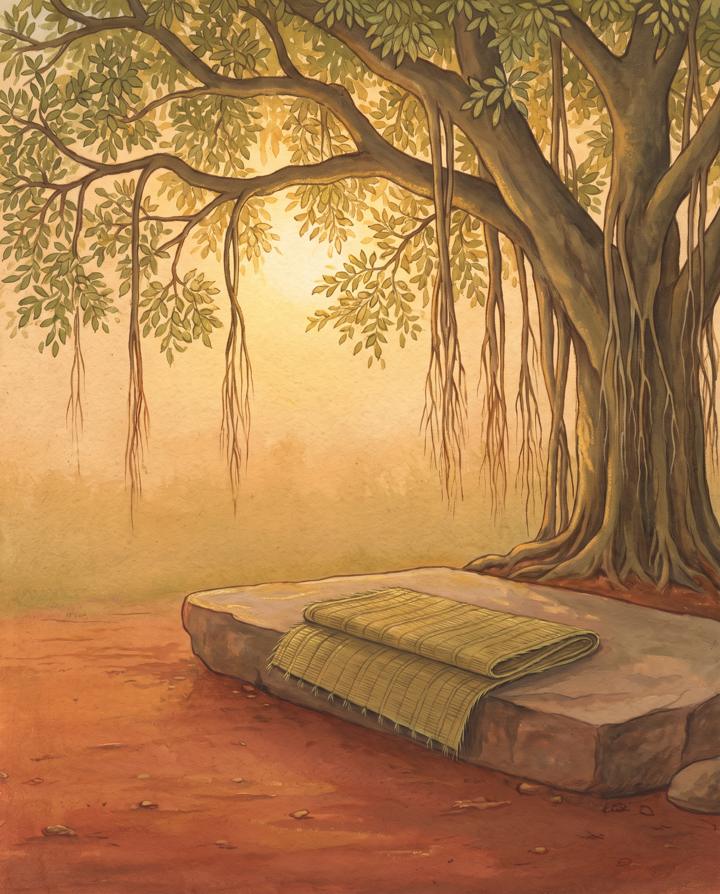
Posture is steady and easeful.
Word by word
- sthira
- steady, firm, stable
- sukham
- easeful, comfortable; one modern etymology, not given by the yoga commentators, derives it from su-kha, 'a good axle-hole'
- āsanam
- posture; literally, a seat
Where it fits
Vyāsa: the restraints and observances have been stated with their powers, and now posture and the rest will be described (Woods p. 191). The third limb is defined by two qualities only, steadiness and ease. Vyāsa lists named seats as examples; 2.47 says how such a posture is achieved.
Reading
This is almost the only thing the Yoga Sūtras say about posture. Āsana means 'seat', the position you sit in to practise, and it asks for two qualities at once: steadiness and ease. Too much effort and the seat turns into a struggle. Too little and it collapses. A modern etymology, not one Vyāsa or Vācaspati gives, derives sukha from su-kha, 'a good axle-hole' in Vedic chariot language. Whatever its history, the image helps: a wheel turns freely when its hub fits. The next sūtra gives the method: relax the effort and let the mind meet the boundless (2.47).
Vyāsa
“For example: the lotus posture, the auspicious posture, the svastika, the staff posture, the posture with a support, the couch, the seated crane, the seated elephant, the seated camel, the even pose, the steady-and-easy, the as-is-comfortable, and others like these.”
Vyāsa's Yoga-bhāṣya, the oldest commentary. New translation from the Sanskrit, with reference to Woods (1914), p. 191.
Practice
Sit in your usual seat. Find the least effort that still keeps you upright. Then, for ten breaths, ask on each inhale 'where is my steadiness?' and on each exhale let go of one place that is gripping more than it needs to.
A question to sit with
Where are you gripping more than you need to?
Where commentators disagree
Is 'sthirasukham āsanam' a definition of posture, the name of one posture, or the start of a sentence finished in 2.47?
- Vācaspati Miśra
- The posture meant is 'steadily comfortable'. Reading the name sthirasukha in Vyāsa's list of postures, he says this is the one posture, among those listed, that the author of the sūtras approves. (Woods 1914, p. 192; Maas 2018, p. 58)
- Bhoja
- Posture is whatever one sits in, such as the lotus, staff or svastika postures. When it becomes steady and not uncomfortable, it counts as a limb of yoga. (Tatya 1885, p. 86; Mitra 1883, wisdomlib on 2.46)
- Philipp A. Maas
- Vyāsa's bhāṣya supplies the verb 'arises', so 2.46 and 2.47 form one sentence: a steady and comfortable posture arises from slackening effort or from merging into the infinite. It is not a general definition of posture. The name sthirasukha in the list is a later variant that misled Woods. (Maas 2018, pp. 57, 59)