II. Sādhana Pāda · Fruits of the observances (2.40–2.45)
2.44 · The Reading Stand
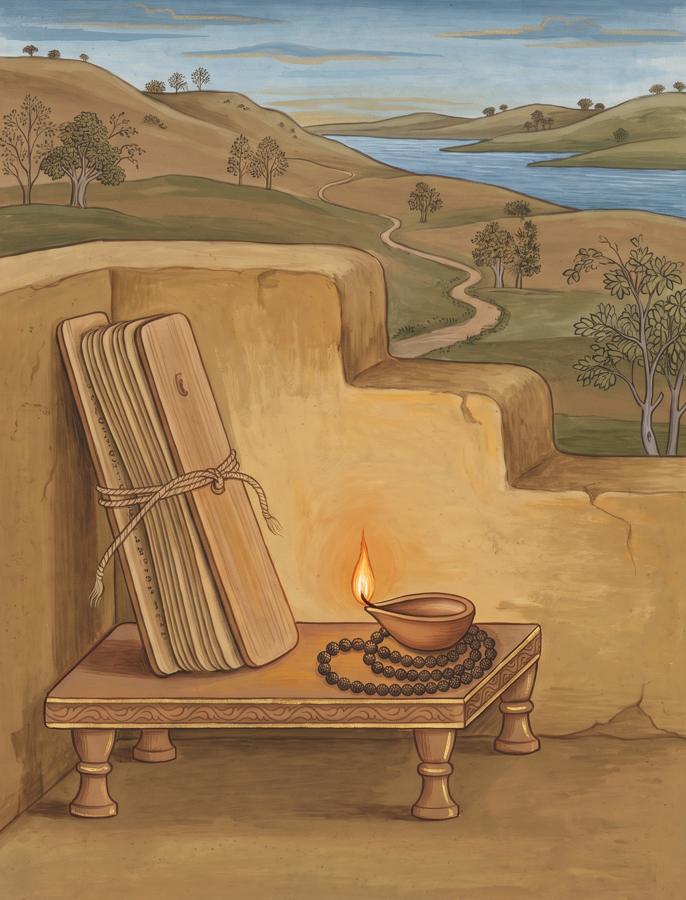
From study comes communion with one's chosen deity.
Word by word
- svādhyāyāt
- from study and recitation of sacred texts
- iṣṭa-devatā
- one's chosen deity
- saṃprayogaḥ
- communion, union
Where it fits
Fourth observance, the second element of 2.1. Study, which Vyāsa defines as reading texts on liberation or repeating Om (Woods p. 182), brings communion with one's chosen deity. Devotion to Īśvara, the last of the three from 2.1, follows (2.45).
Reading
Svādhyāya, study and recitation of sacred texts, originally meant reciting them aloud; Vyāsa defines it as reciting the texts on liberation or repeating Om. Its fruit, he says, is that gods, sages and perfected beings come into view of one devoted to study, and help in their work. Patañjali does not say which deity: the choice is yours. For some readers this is literal. For others, one way to read it today, the 'chosen deity' is the ideal that study brings alive.
Vyāsa
“Gods, sages and perfected beings appear to someone devoted to study, and they help him in his work.”
Vyāsa's Yoga-bhāṣya, the oldest commentary. New translation from the Sanskrit, with reference to Woods (1914), p. 190.
Practice
Choose a short text you love: this sūtra, a prayer, a poem. Recite it aloud slowly eleven times, then sit quietly for a few minutes afterwards.
A question to sit with
What does your study bring near?
Where commentators disagree
What kind of svādhyāya is meant here, and who is the 'chosen deity' it brings?
- Vyāsa
- Svādhyāya is the recitation of texts on liberation or the repetition of the syllable Oṃ (on 2.32). Here he says that gods, sages and perfected beings come into view of one given to study, and help him in his work. (Woods 1914, pp. 182, 190)
- Bhoja
- Svādhyāya is japa, the repetition of a chosen mantra. When it is perfected, the deity to whom the mantra is addressed becomes visible to the yogin. (Tatya 1885, p. 85; Mitra 1883, wisdomlib on 2.44)
- Rajendralala Mitra
- Svādhyāya ordinarily means study of the Veda, but here it is used in the technical sense of repeating a mantra many times, much like counting a rosary. (Mitra 1883, note on 2.44 (wisdomlib))
Key ideas
kriyā-yoga (the yoga of action), praṇava (Om), siddhi (powers)