II. Sādhana Pāda · Fruits of the observances (2.40–2.45)
2.40 · The Morning Bath
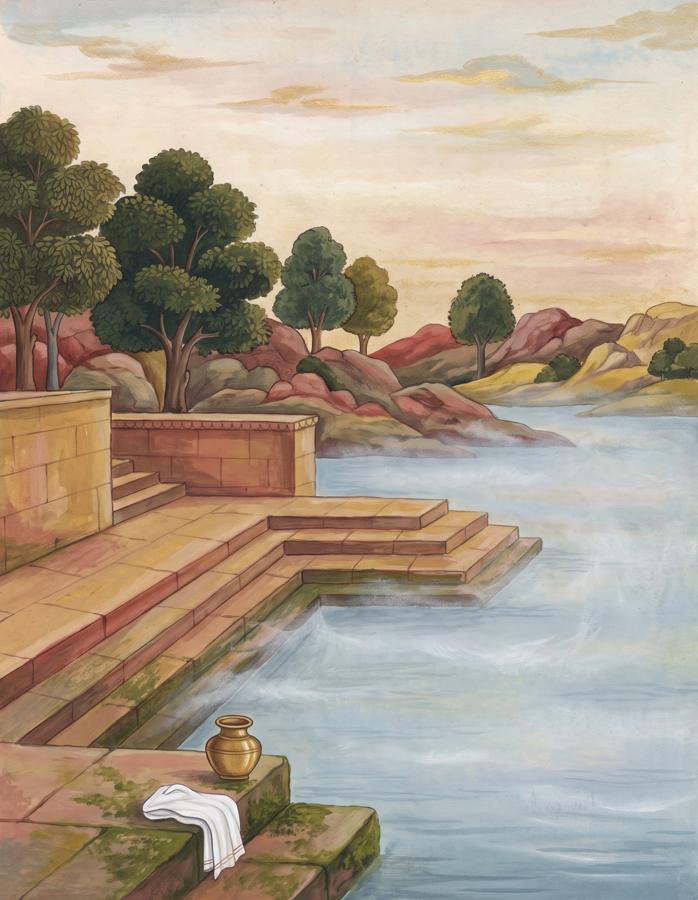
From purity comes distaste for one's own body and non-contact with others.
Word by word
- śaucāt
- from purity
- sva-aṅga
- one's own body
- jugupsā
- disgust, distaste
- paraiḥ
- with others
- asaṃsargaḥ
- non-contact
Where it fits
Vyāsa: we will now speak of the observances (Woods p. 188). Their fruits follow the order of 2.32, beginning with purity. Its fruit is distaste for one's own body and no contact with others' bodies; Vyāsa ties this to seeing that washing never makes the body lastingly pure. 2.41 gives purity's further fruits.
Reading
The fruits of the observances begin with the hardest sūtra for modern ears, and it should be heard as it is. Jugupsā is a strong word: disgust. Vyāsa's reasoning is that even after washing, one sees no lasting purity in the body, stops being attached to it and becomes an ascetic. The text was written with renunciants in mind. One gentler way to read it today: daily washing shows how much care the body needs, so you hold it more lightly. Readers differ in how literally they take it.
Vyāsa
“Seeing the body's flaws, he is no longer attached to it and becomes an ascetic. … Seeing no purity in the body, how could he mix with the bodies of others, which are wholly unclean?”
Vyāsa's Yoga-bhāṣya, the oldest commentary. New translation from the Sanskrit, with reference to Woods (1914), p. 188.
Practice
Take your bath or shower today as a practice. Treat the body as something cared for rather than owned or admired.
A question to sit with
How tightly do you hold your body's image?
Where commentators disagree
Does śauca lead to 'disgust' with one's own body, and is that its aim?
- Vyāsa
- One begins cleanliness out of disgust with one's own body. Seeing its offensiveness, one is no longer attached to it and becomes an ascetic; finding no purity in one's own body however washed, one does not seek contact with the bodies of others. (Woods 1914, p. 188)
- Bhoja
- From discerning the cause and nature of the body comes loathing even for one's own limbs, 'This body is impure; no fondness for it should be cherished', and so avoidance of contact with others. (Tatya 1885, pp. 82–83; Mitra 1883, wisdomlib on 2.40)
- Rajendralala Mitra
- Observes that the purity defined at 2.32 is here magnified until one loathes one's own body and, all the more, all bodies. (Mitra 1883, note on 2.40 (wisdomlib))
- Rama Prasad
- Renders jugupsā more mildly as 'disinclination to one's body', though his Vyāsa still speaks of disgust. (Rama Prasad 1912, p. 166)