II. Sādhana Pāda · Seer and seen (2.18–2.25)
2.23 · The Meeting
The joining of the owned and the owner is what lets the own nature of both powers be known.
Word by word
- sva
- the owned (nature)
- svāmin
- the owner (the seer)
- śaktyoḥ
- of the two powers
- svarūpa
- own nature
- upalabdhi
- recognition, coming to know
- hetuḥ
- the cause
- saṃyogaḥ
- joining
Where it fits
Vyāsa says this sūtra sets out what the joining itself is (Woods p. 160). Its purpose is that each side comes to be known: knowing the seen is experience, knowing the seer's own nature is freedom. Vyāsa then reviews rival views of the "not-seeing" behind the joining (Woods pp. 161–162), before 2.24 narrows the question.
Reading
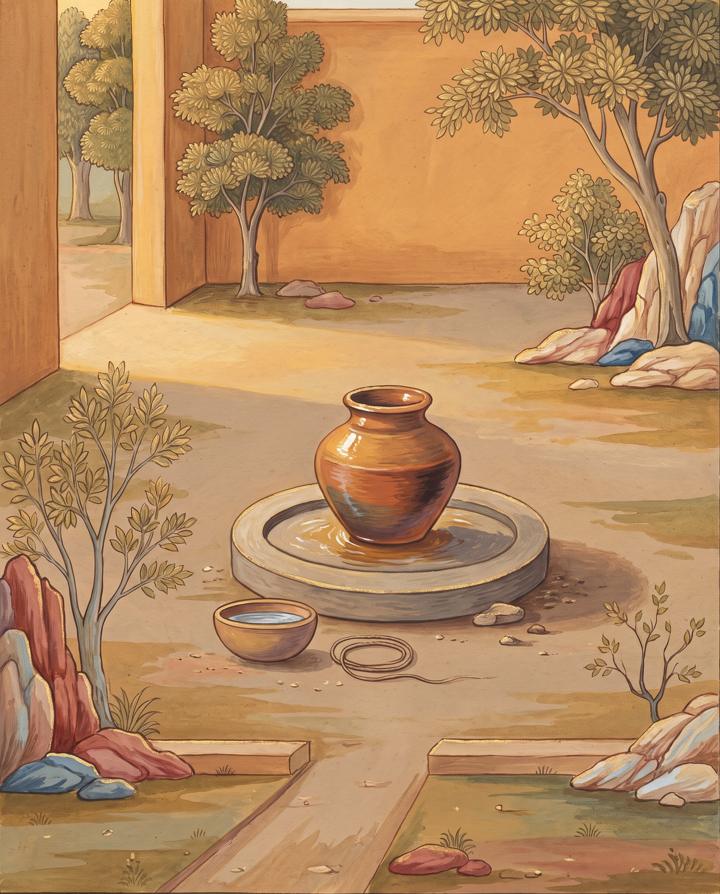
Why does the joining of seer and seen happen at all? So that the nature of each can be recognised. We learn what we are by meeting what we are not. The entanglement of 2.17 is painful, but it is not pointless: it is how awareness comes to know itself, the way clay shows its nature only on the wheel.
Vyāsa
“The joining lasts until seeing has done its work, so seeing is called the cause of separation. … Here seeing is not the cause of liberation. Bondage ends simply because not-seeing ends, and that is liberation.”
Vyāsa's Yoga-bhāṣya, the oldest commentary. New translation from the Sanskrit, with reference to Woods (1914), p. 161.
Practice
Recall a time when a difficulty showed you something about yourself you could not have learned any other way. Write it down in one sentence. If the memory is still painful, choose a lighter one, or stop and come back to the breath.
A question to sit with
What is this meeting teaching you about yourself?
Where commentators disagree
What exactly is the 'not-seeing' that joins seer and seen?
- Vyāsa
- He sets out eight answers 'found in the books': for example, that it is the authority of the guṇas, the stored latent purposes of the guṇas, ignorance as the seed of a new mind, or simply the power of seeing itself. He says all of them concern the same thing, the joining of selves with the guṇas. (Woods 1914, pp. 161–162)
- Vācaspati Miśra
- Vyāsa lists the alternatives in order to accept the fourth, ignorance as the seed of each person's own mind. The other seven fail because they would be common to all selves and could not explain why each person's experience differs. (Woods 1914, p. 165)
- Bhoja
- The conjunction is nothing other than the beginningless relation of the experienced and the experiencer. Since both are eternal and all-pervading, there is no conjunction apart from their essential natures. (Tatya 1885, pp. 68–69; Mitra 1883, wisdomlib on 2.23)
Key ideas
puruṣa (the seer, the self), prakṛti (nature, the seen), viveka (discernment)