I. Samādhi Pāda · Ways to a clear mind (1.33–1.39)
1.38 · The Sleeping Village
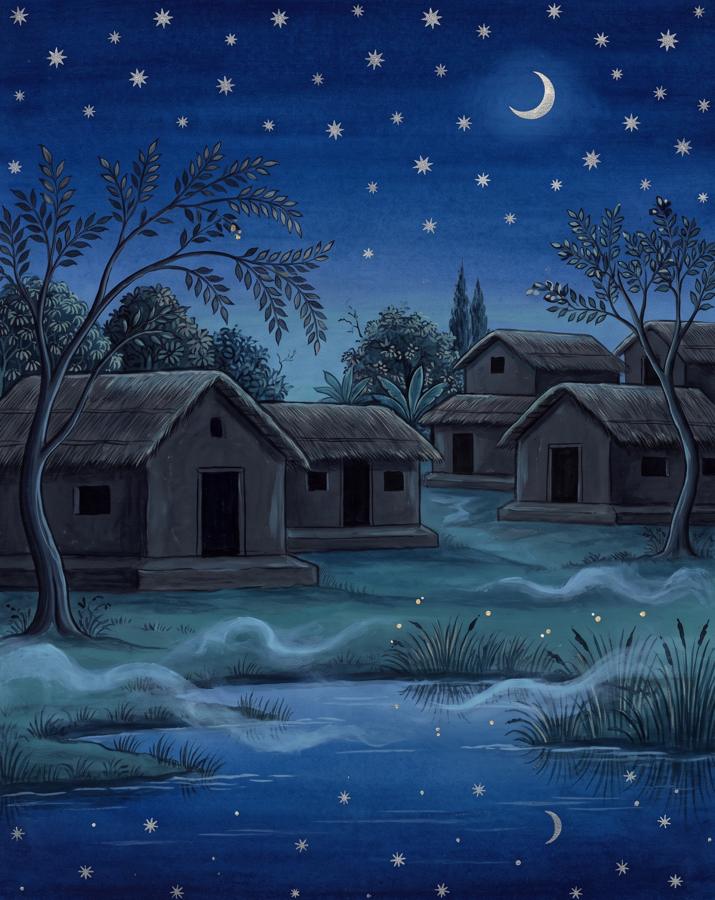
Or a mind that rests on the knowledge that comes in dreams and sleep.
Word by word
- svapna
- dream
- nidrā
- sleep
- jñāna
- knowledge, perception
- ālambanam
- as support
- vā
- or
Where it fits
The list reaches its least likely supports: knowledge from dream and from sleep. Sleep was a movement to be stilled at 1.10; here what it gives can steady the mind. Vyāsa says only that the mind takes their form and grows steady (Woods p. 76). 1.39 then opens the list completely.
Reading
Even dream and deep sleep can become supports. Vyāsa says only that the mind may take a perception from dream or sleep as its object and grow steady. Vācaspati Miśra gives a vivid example: someone dreams of worshipping a moonstone image of Śiva in a forest, wakes calm, and returns to that image in meditation. He also points to the quiet of good sleep, remembered on waking as 'I slept well'. Readers differ on whether the sūtra means dream content or the peaceful quality of sleep itself.
Vyāsa
“Or, taking as its support the knowledge that comes in dream or the knowledge that comes in sleep, and taking on its form, the yogi's mind reaches steadiness.”
Vyāsa's Yoga-bhāṣya, the oldest commentary. New translation from the Sanskrit, with reference to Woods (1914), p. 76.
Practice
Tonight, before sleep, recall the most peaceful moment of the day and rest in it until you drift off. In the morning, before reaching for anything, notice the quiet you woke from and stay with it for one minute.
A question to sit with
What did your sleep leave you with?
Where commentators disagree
What dream or sleep can serve as a support for the mind in 1.38?
- Vyāsa
- The mind takes as its support a perception had in dream or in sleep, assumes that form, and becomes steady. (Woods 1914, p. 76)
- Vācaspati Miśra
- Gives an example: in a dream one worships a moon-pale image of Maheśvara in a quiet forest, and on waking, calm, one dwells on that same image. The sleep meant is sleep of the sattva kind, remembered on waking as 'I slept well'. (Woods 1914, pp. 76–77)
- Bhoja
- Dream is experience by the mind alone when the outer senses have withdrawn; knowledge drawn from dream or from sleep, when dwelt on, steadies the mind. (Tatya 1885, p. 34; Mitra 1883, wisdomlib on 1.38)