I. Samādhi Pāda · Kinds of absorption (1.17–1.22)
1.18 · Embers Under Ash
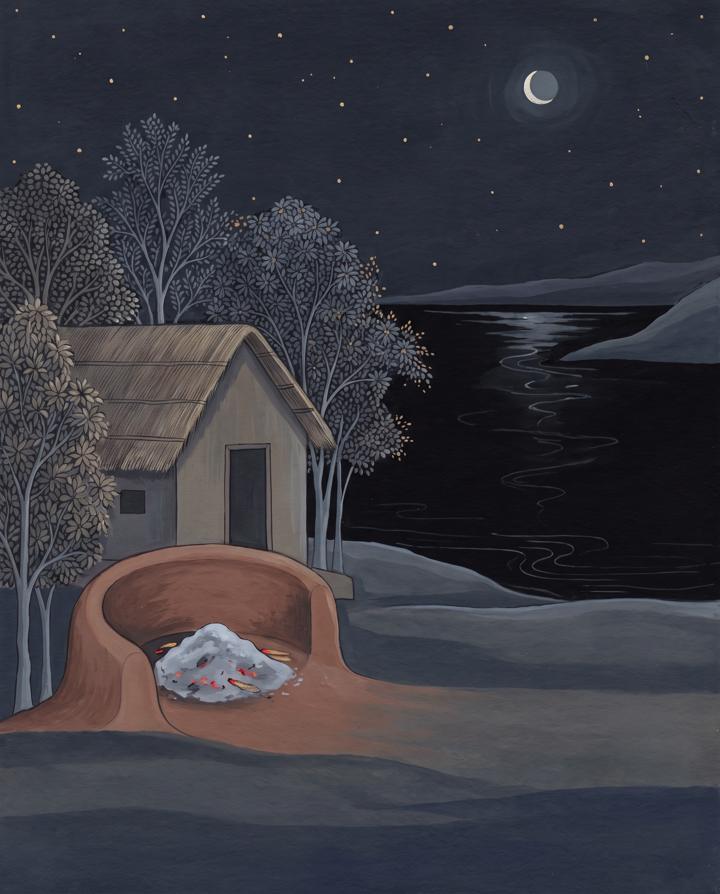
The other absorption follows practice in letting thought cease; only latent impressions remain.
Word by word
- virāma
- cessation, stopping
- pratyaya
- the cause; content of mind
- abhyāsa
- practice
- pūrvaḥ
- preceded by
- saṃskāra
- latent impressions
- śeṣaḥ
- remainder, what is left
- anyaḥ
- the other
Where it fits
Vyāsa asks the means and nature of absorption without an object (Woods p. 41). Its means, he says, is the higher non-attachment of 1.16, since practice that rests on an object cannot reach beyond objects. The latent impressions that remain set up the problem that 1.50–1.51 resolve.
Reading
The other absorption has no object at all. It comes from practising the ceasing of thought, and in it only latent impressions remain: the seeds of future thoughts, lying inactive. Vyāsa says its means is the higher non-attachment of 1.16, since practice that leans on an object cannot lead beyond objects. In it, he says, the mind seems as if it did not exist. Vyāsa names it asaṃprajñāta, absorption without an object. The seeds that remain are taken up again at 1.50–1.51.
Vyāsa
“Its means is the higher non-attachment. For practice that has an object cannot serve to bring it about. … Prepared by practising this [thought of cessation], the mind is without an object and becomes as if it no longer existed.”
Vyāsa's Yoga-bhāṣya, the oldest commentary. New translation from the Sanskrit, with reference to Woods (1914), p. 42.
Practice
Sit for five minutes and breathe naturally. After each breath out, notice the short pause before the next breath comes by itself. Don't lengthen it or add anything. Simply rest there, and notice what is left when nothing is happening.
A question to sit with
What is left when nothing is happening?
Key ideas
samādhi (absorption), saṃskāra (latent impressions), vairāgya (non-attachment), abhyāsa (practice)