I. Samādhi Pāda · Kinds of absorption (1.17–1.22)
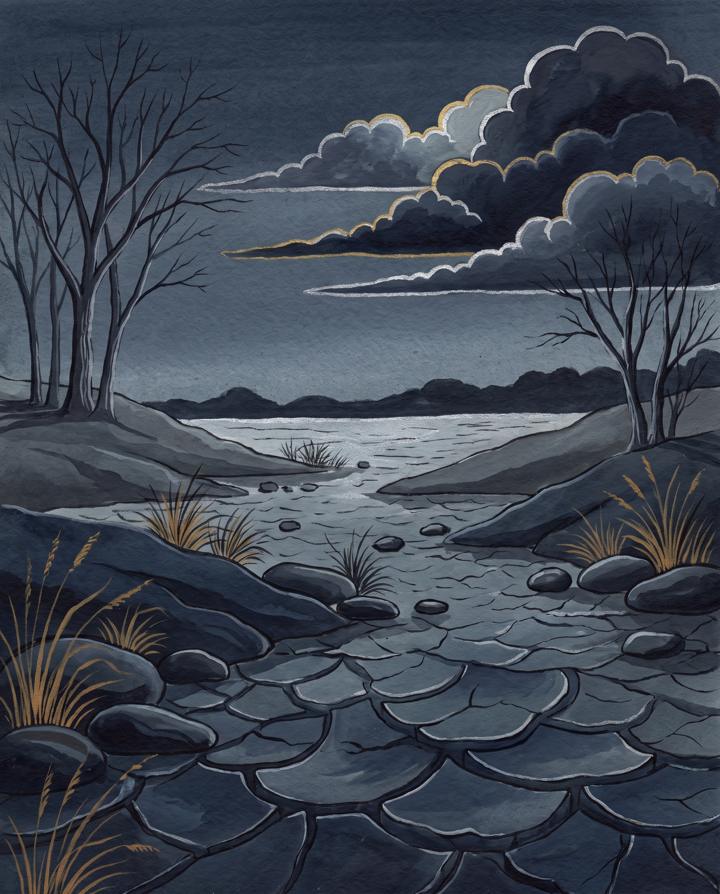
1.19 · The Dry Riverbed
For the bodiless and those dissolved in nature, it arises from their state of being.
Word by word
- bhava
- being, birth, becoming
- pratyayaḥ
- cause, basis
- videha
- the bodiless
- prakṛti
- nature, primal matter
- layānām
- of those dissolved in
Where it fits
Vyāsa divides objectless absorption in two: one arising from means, which yogis reach, and one arising from a state of being (Woods p. 43). This sūtra treats the second. For the bodiless and those dissolved in nature it resembles liberation but ends when the mind returns. 1.20 gives the yogis' way.
Reading
One of the hardest sūtras. Some beings reach a state like objectless absorption simply because of what they are: the bodiless, and those dissolved into nature. Vyāsa takes the bodiless to be gods, and says both enjoy something like liberation for a time: the gods until their store of impressions is spent, those dissolved in nature until the mind, its work unfinished, returns. For us it is a warning: a state can resemble liberation and still be temporary. Commentators read bhava differently: Vācaspati Miśra as worldly ignorance, Vijñānabhikṣu as birth.
Vyāsa
“For the bodiless, that is, the gods, it arises from their state of being. With minds that draw only on their own latent impressions, they experience something like the state of liberation … until the mind, under the force of its unfinished task, returns.”
Vyāsa's Yoga-bhāṣya, the oldest commentary. New translation from the Sanskrit, with reference to Woods (1914), p. 43.
Practice
Think of a time you felt free because life was easy: a holiday, a quiet week. Write down what happened when circumstances changed. Then name one practice that could help that ease outlast the good conditions, and do it today.
A question to sit with
Is your calm earned or borrowed?
Where commentators disagree
What is bhava-pratyaya, and who are the bodiless and those dissolved in nature?
- Vyāsa
- The bodiless are gods. They and those dissolved in nature enjoy something like isolation, but only for a time: the mind, its task unfinished, returns to the world. (Woods 1914, p. 43)
- Vācaspati Miśra
- Bhava means avidyā, ignorance, 'the world' in which beings are born. These beings took the self to be something that is not the self, such as the elements, the senses or nature, and merged with it. (Woods 1914, p. 44)
- Vijñānabhikṣu
- Rejects Vācaspati's reading and takes bhava-pratyaya as 'caused by birth'. Woods thinks he wrongly treats the passage as a classification of two kinds of objectless absorption. (Woods 1914, p. 44, n. 1)
- Bhoja
- The cause here is the manifest world, and this state is only a false semblance of absorption. The bodiless are those absorbed in ānanda meditation, those dissolved in nature are those who stop at asmitā; neither sees the self as distinct. (Tatya 1885, pp. 17–18)
Key ideas
samādhi (absorption), prakṛti (nature, the seen), saṃskāra (latent impressions)