III. Vibhūti Pāda · Inner maps (3.25–3.34)
3.33 · Dawn on the Spire
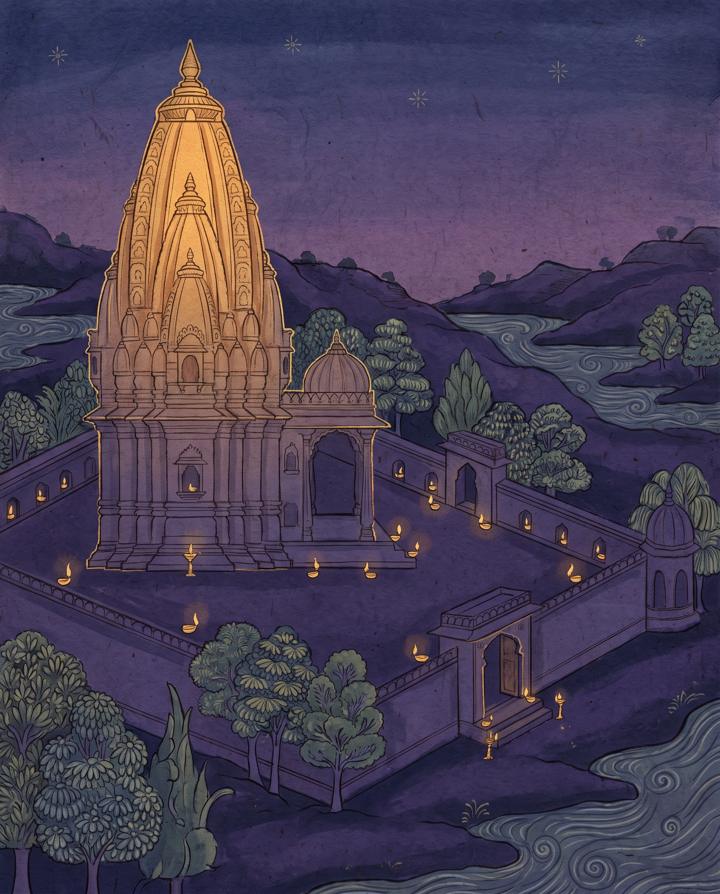
Or everything, through intuition.
Word by word
- prātibhāt
- through intuition, the flash of insight
- vā
- or
- sarvam
- everything
Where it fits
A turn in the list. Everything the separate saṃyamas give can come 'or' through intuition. Vyāsa calls intuition tāraka, the first form of the knowledge born of discernment, as dawn comes before the sun (p. 261). The full sun is 3.54, where the same word returns.
Reading
The small word 'or' matters. Everything the separate saṃyamas give can also come through prātibha, intuition: a knowing that arrives whole, without steps. Vyāsa calls it tāraka, 'the one that carries across', the first form of the knowledge born of discernment, and gives an image: it comes as the glow at dawn comes before the sun. The full sun is 3.54, which uses the same word. Intuition here is a fruit of long practice, and it is different from a hunch.
Vyāsa
“Intuition is what is called 'the one that carries across' (tāraka). It is the first form of the knowledge born of discernment, as the glow at dawn comes before the sun. Or by this means the yogi knows everything, once intuitive knowledge has arisen.”
Vyāsa's Yoga-bhāṣya, the oldest commentary. New translation from the Sanskrit, with reference to Woods (1914), p. 261.
Practice
After a sitting today, rest for a minute and notice any understanding that arrives whole rather than argued. Write it down, but don't act on it yet. Later, test it against the facts. Over time you learn the difference between this kind of knowing and a passing hunch.
A question to sit with
What do you already know, before the reasons arrive?
Where commentators disagree
What is prātibha, the 'flash' that knows everything, and why is it called tāraka?
- Vyāsa
- Prātibha is called tāraka, the 'deliverer'. It is the first form of the knowledge born of discrimination, like the light of dawn before the sun; by it the yogin knows all. (Woods 1914, p. 261)
- Vācaspati Miśra
- It grows from self-reflection (ūha) in one practising saṃyama towards the highest discernment. Because it brings that discernment near and so frees from rebirth, it is called the deliverer. (Woods 1914, pp. 261–262)
- Bhoja
- Pratibhā is knowledge that arises in the mind alone, without an outer cause, uncontradicted and sudden. Once it has arisen, the yogin knows everything without any particular saṃyama. (Tatya 1885, p. 121; Mitra 1883, wisdomlib on 3.33)
- Rajendralala Mitra
- Suggests that Vyāsa's tāraka could mean the morning star, which appears before sunrise, as well as 'deliverer'. He leaves open whether a yogin should think of the star or of intuition, but judges that Bhoja has the better of the argument. (Mitra 1883, note on 3.33 (wisdomlib))