III. Vibhūti Pāda · Inner maps (3.25–3.34)
3.29 · The Navel Wheel
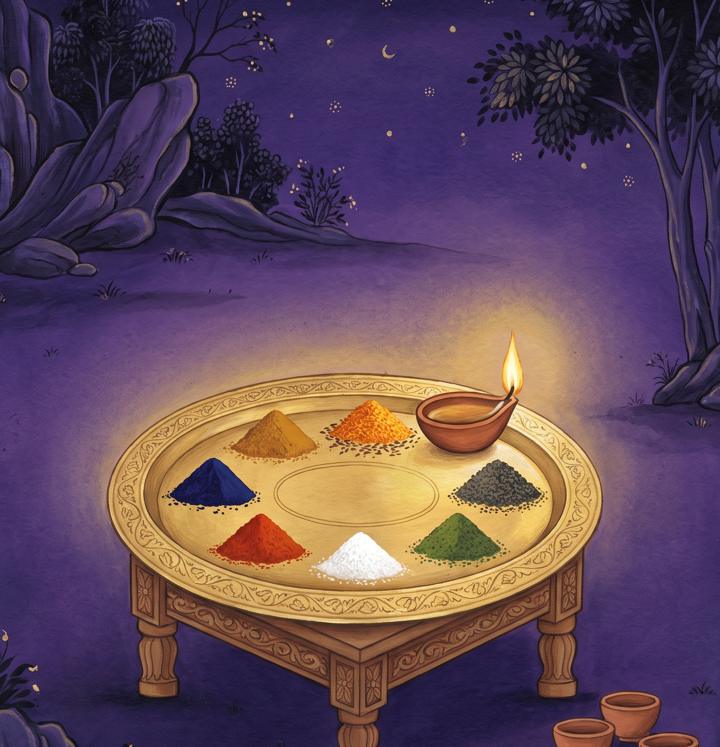
On the navel circle, knowledge of the arrangement of the body.
Word by word
- nābhi-cakre
- on the circle, the wheel, of the navel
- kāya-vyūha
- the arrangement of the body
- jñānam
- knowledge
Where it fits
Saṃyama turns from the sky to the body. The navel circle, one of Vyāsa's places for concentration at 3.1, gives knowledge of the body's arrangement. Vyāsa lists the humours and tissues of the medicine of his day (p. 260). 3.30–3.32 move upward through throat, chest and head.
Reading
Having turned saṃyama on the moon and the pole star (3.27–3.28), Patañjali now turns it inward. Saṃyama on the navel, he says, gives knowledge of how the body is ordered. Vyāsa fills this in with the medicine of his day: three humours, wind, bile and phlegm, and seven tissues, from skin through blood, flesh, sinew, bone and marrow to semen. Later haṭha yoga made the navel a cakra in a system of centres; whether Patañjali meant more than 'the circle of the navel' is debated.
Vyāsa
“By making saṃyama on the navel circle, one may know the arrangement of the body. The humours are three: wind, bile and phlegm. The tissues are seven: skin, blood, flesh, sinew, bone, marrow and semen.”
Vyāsa's Yoga-bhāṣya, the oldest commentary. New translation from the Sanskrit, with reference to Woods (1914), p. 260.
Practice
Lie on your back for five minutes with one hand resting on your navel. Let the breath move as it likes. Notice the rise and fall under your hand, any warmth, any sounds of digestion. Get to know the centre of the body by feeling, not by diagram.
A question to sit with
What is your body telling you from its centre?
Where commentators disagree
What is the 'wheel at the navel', and what does saṃyama on it reveal?
- Vyāsa
- By saṃyama on the wheel of the navel one would know the arrangement of the body: the three humours, wind, bile and phlegm, and the seven tissues, skin, blood, flesh, sinew, bone, marrow and semen, each lying outside the next. (Woods 1914, p. 260)
- Bhoja
- The navel wheel in the middle of the body has sixteen spokes and is the root of all the body's channels, so knowing it shows how fluids, humours and channels are arranged. (Tatya 1885, p. 119; Mitra 1883, wisdomlib on 3.29)
- Rajendralala Mitra
- Cannot see how the idea of a sixteen-spoked wheel arose, since no such thing is found when a body is opened, and suspects a hidden metaphor. (Mitra 1883, note on 3.29 (wisdomlib))