II. Sādhana Pāda · The afflictions (2.3–2.9)
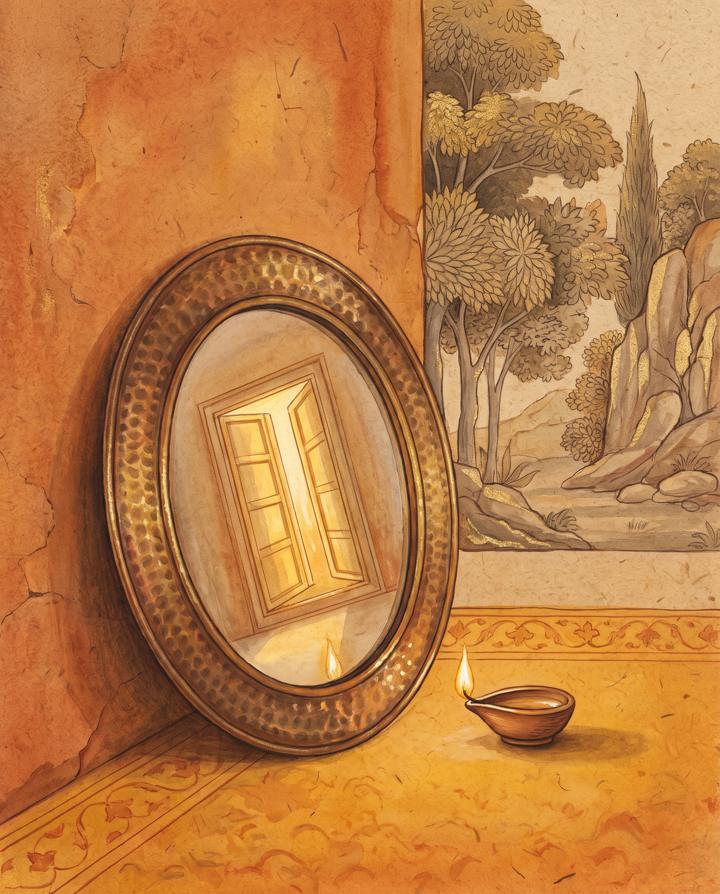
2.6 · The Mirror
I-am-ness is the seeming oneness of the power that sees and the instrument of seeing.
Word by word
- dṛk
- the seer; the power of seeing
- darśana
- the instrument of seeing
- śaktyoḥ
- of the two powers
- ekātmatā
- being one self
- iva
- as if
- asmitā
- I-am-ness
Where it fits
The second affliction grows from the last mistake of 2.5, the not-self taken for the self. Here that mistake is placed exactly: between the power that sees and the instrument it sees with. The same pair returns as seer and seen in 2.17–2.20, where the text shows how their confusion causes suffering.
Reading
I-am-ness is taking the instrument of seeing for the one who sees: mistaking the mind and its contents for awareness itself. The key word is iva, 'as if'. The two only seem to be one. The mind reflects awareness so faithfully, like a mirror holding a face, that we forget which is which, and call the reflection 'me'.
Vyāsa
“The self is the power that sees; the intellect is the instrument of seeing. When these two seem to merge into a single nature, that is the affliction called I-am-ness. … But when each regains its own nature, there is freedom.”
Vyāsa's Yoga-bhāṣya, the oldest commentary. New translation from the Sanskrit, with reference to Woods (1914), p. 115.
Practice
Sit for five minutes. Each time you notice a thought, add 'is being seen'. 'Worry about money is being seen.' 'Plan for lunch is being seen.' Notice what is doing the seeing.
A question to sit with
What are you calling 'me' that is really something you see?
Key ideas
kleśa (afflictions), puruṣa (the seer, the self), avidyā (ignorance)