II. Sādhana Pāda · Withdrawal of the senses (2.54–2.55)
2.55 · The Quiet Horses
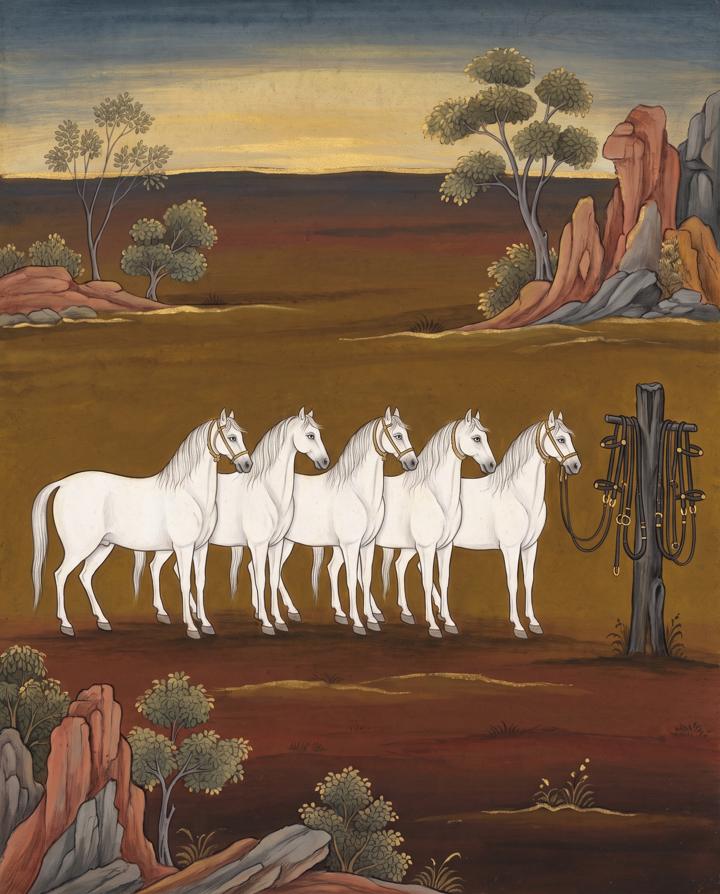
Then comes supreme mastery of the senses.
Word by word
- tataḥ
- from that
- paramā
- supreme
- vaśyatā
- mastery, obedience
- indriyāṇām
- of the senses
Where it fits
The pāda ends with the fruit of withdrawal: supreme mastery of the senses. Vyāsa reviews several views of mastery and ranks highest the one where the mind is one-pointed and the senses do not go out at all (Woods pp. 198–199). With the outer limbs complete, the third pāda opens with concentration (3.1).
Reading
The Sādhana Pāda ends on the fruit of withdrawal, and Vyāsa weighs several views of what mastery of the senses is: not being addicted to sense objects, using the senses freely as one wishes, meeting objects without liking or disliking. He calls supreme Jaigīṣavya's view: when the mind is one-pointed, the senses simply do not go out to their objects. This is not numbness forced on the senses; they rest because the mind rests, and no further effort is needed. The pāda leaves the reader on the threshold of concentration (3.1).
Vyāsa
“Jaigīṣavya holds that it is simply not perceiving [sense objects] at all, because the mind is one-pointed. And so this is the supreme mastery: when the mind is stilled, the senses are stilled …”
Vyāsa's Yoga-bhāṣya, the oldest commentary. New translation from the Sanskrit, with reference to Woods (1914), p. 198–199.
Practice
Sit for five minutes and give the mind one point, such as the breath at the nostrils. Don't fight sounds or sensations. As the mind gathers, notice whether the senses quiet by themselves, the way the bees of 2.54 settle with their king.
A question to sit with
What happens to your senses when your mind is gathered?
Where commentators disagree
What is real mastery of the senses?
- Earlier teachers reported by Vyāsa
- Some say mastery is not craving sense objects; others that it is enjoying what is not forbidden; others that it is meeting objects at will; others that it is perceiving them without pleasure or pain, liking or dislike. (Woods 1914, p. 198)
- Jaigīṣavya, as reported by Vyāsa
- Mastery is not perceiving sense objects at all, because the mind is one-pointed. Vyāsa calls this the complete mastery: when the mind is stilled, the senses are stilled with it and need no separate effort. (Woods 1914, pp. 198–199)
- Vācaspati Miśra
- The other kinds are incomplete because they stay in contact with the poisonous snake of sense objects. Even an expert in snakes does not take one on his lap and go to sleep. (Woods 1914, p. 199)
- Bhoja
- When withdrawal is practised, the senses are so subdued that even when drawn towards outer objects they do not go. (Tatya 1885, p. 91)
Key ideas
pratyāhāra (withdrawal of the senses), saṃyama (holding together)