II. Sādhana Pāda · Withdrawal of the senses (2.54–2.55)
2.54 · Bees Returning
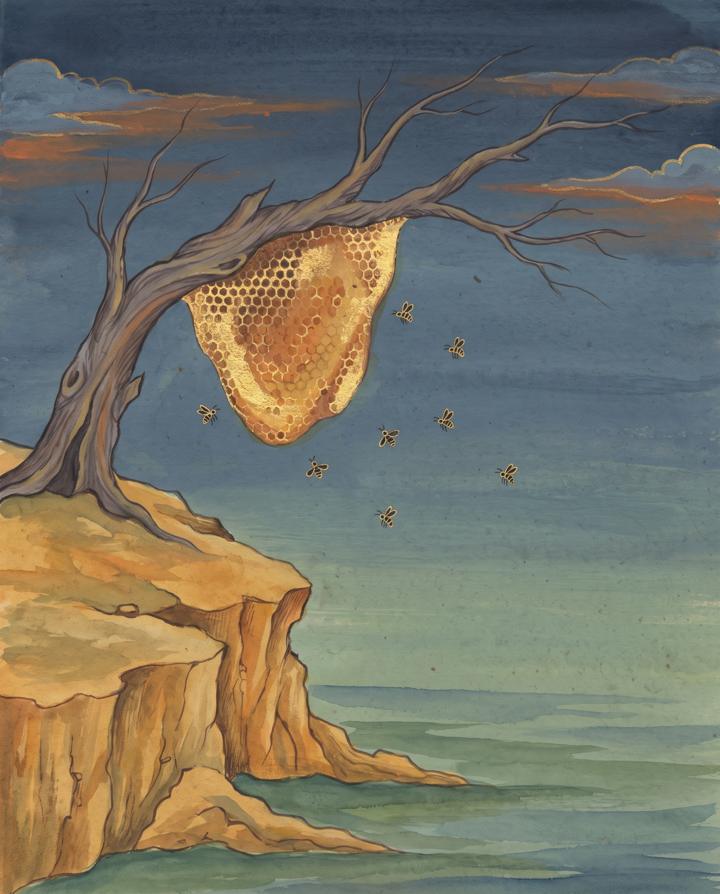
Withdrawal is when the senses, no longer engaged with their objects, seem to follow the mind's own nature.
Word by word
- sva-viṣaya
- their own objects
- asaṃprayoge
- when not in contact
- citta-svarūpa
- the mind's own form
- anukāraḥ
- imitation, following
- iva
- as if
- indriyāṇām
- of the senses
- pratyāhāraḥ
- withdrawal of the senses
Where it fits
Vyāsa asks, "Now what is withdrawal?" (Woods p. 197). The fifth limb is the last of the outer ones. The senses, disengaged from their objects, follow the mind as it turns inward, as bees follow their king in Vyāsa's image. Its fruit closes the pāda (2.55).
Reading
Pratyāhāra is the fifth limb and the last of the outer ones, and the small word iva, 'as if', is exact: the senses do not become mind, they share its turning away. Vyāsa's image is the bees and their king: when the king bee flies up, the swarm flies up, and when it settles, they settle. So when the mind is stilled, the senses come home with it, without being forced. Unlike other ways of governing the senses, he says, this needs no further means.
Vyāsa
“Just as, when the king bee flies up, the bees fly up after it, and when it settles, they settle after it, so when the mind is stilled, the senses are stilled. This is withdrawal.”
Vyāsa's Yoga-bhāṣya, the oldest commentary. New translation from the Sanskrit, with reference to Woods (1914), p. 197.
Practice
Sit with your eyes closed for five minutes. Each time a sense pulls you out, whether a sound, an itch or a smell, notice it, then let attention return inward like a bee returning to the hive.
A question to sit with
Where are your senses dragging you?
Key ideas
pratyāhāra (withdrawal of the senses), citta (the mind-field)