I. Samādhi Pāda · Īśvara and Om (1.23–1.29)
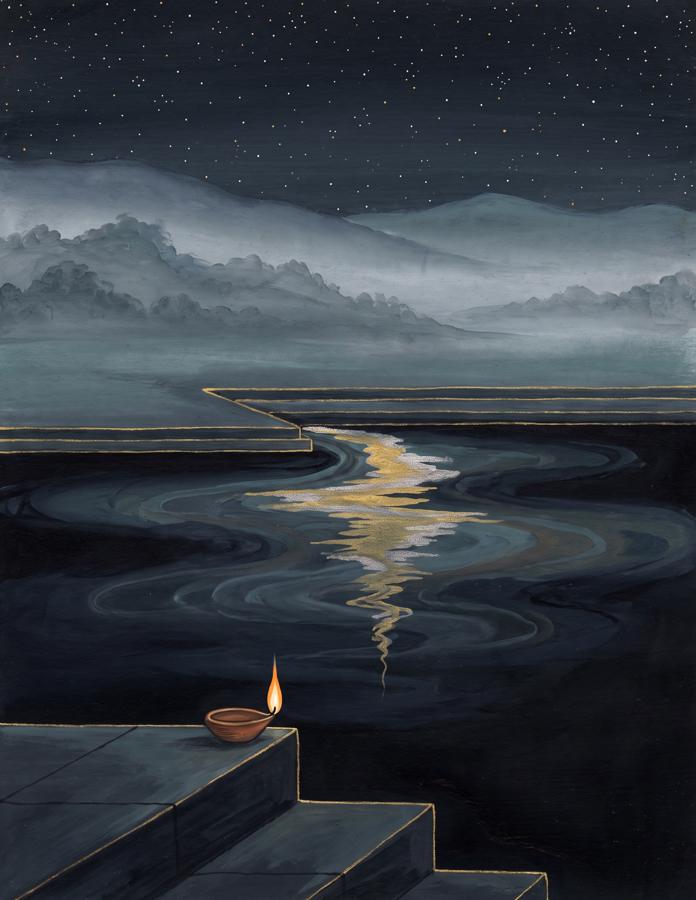
1.27 · Light of the Lamp
The word that names Īśvara is the praṇava, Om.
Word by word
- tasya
- of that, of Īśvara
- vācakaḥ
- the word that expresses it, its name
- praṇavaḥ
- the resounding syllable, Om
Where it fits
Devotion (1.23) needs a way in. Having described Īśvara (1.24–1.26), Patañjali gives the name, Om. Vyāsa asks whether the bond between this word and what it names is convention or something fixed, and holds that it is fixed (Woods p. 60). That matters for 1.28, where the name is repeated.
Reading
Īśvara has a name, and it is Om, the praṇava, the syllable that opens and closes Vedic recitation. Vyāsa asks whether the bond between this word and what it names is fixed, like a lamp and its light, or a mere human convention. He answers that it is fixed. Usage only declares it, the way people point out a father and son whose relation already exists. In much of the Hindu tradition Om is felt as the sacred itself, sounding. The next sūtra says what to do with it.
Vyāsa
“Īśvara is what Om expresses. Is this bond between word and meaning made by convention, or does it stand fixed, like a lamp and its light? The relation between what is expressed here and the word that expresses it is fixed.”
Vyāsa's Yoga-bhāṣya, the oldest commentary. New translation from the Sanskrit, with reference to Woods (1914), p. 60.
Practice
Say Om once, slowly and quietly, letting the sound move from the open 'a' through the 'u' to the closed 'm', and then into silence. Listen to the silence for as long as the sound lasted. Repeat three times.
A question to sit with
What name do you give to what is highest?