II. Sādhana Pāda · Discernment (2.26–2.28)
2.27 · The Seven Steps
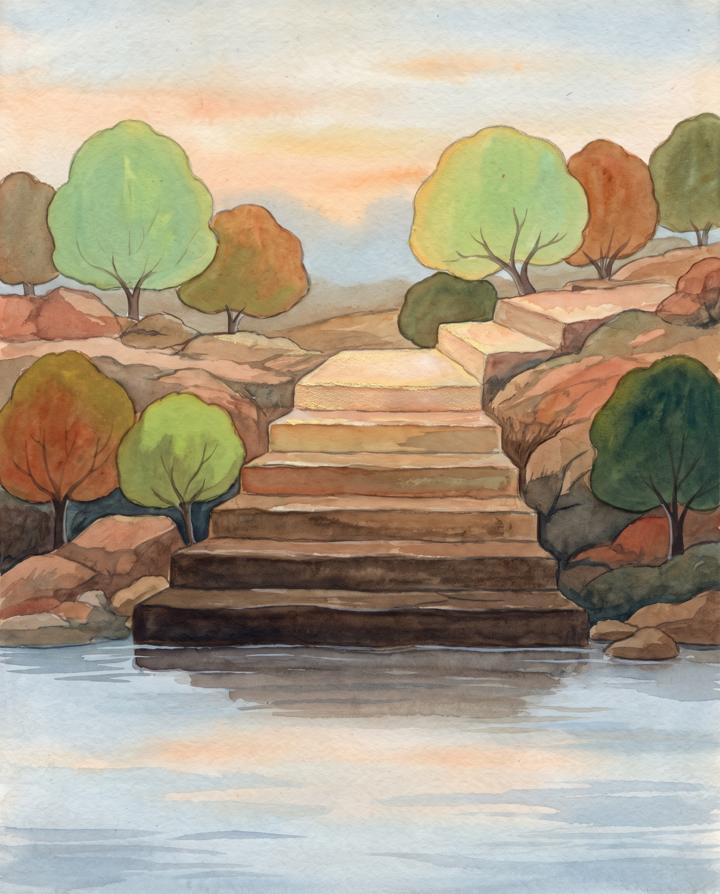
Its wisdom reaches the final ground in seven stages.
Word by word
- tasya
- of that one (who has discernment)
- saptadhā
- sevenfold
- prānta-bhūmiḥ
- reaching the final ground
- prajñā
- wisdom
Where it fits
Steady discernment (2.26) yields wisdom in seven stages. Vyāsa's first four echo the frame of 2.15: what is to be avoided is fully known, its causes are worn away, release is directly seen, the means is fully developed. The last three are the mind's own release, ending with the self alone (Woods pp. 170–171).
Reading
Steady discernment does not end in one flash; it ripens through stages. Patañjali doesn't list them, but Vyāsa does: the first four concern the work being finished, and the last three the mind coming to rest and the seer standing alone. Vācaspati notes that the first four can be completed by a person's effort, while the last three follow after and are not brought about by effort. The message for the practitioner is simple: the path has stages, and each can be recognised when it is reached.
Vyāsa
“The guṇas, like boulders fallen from the edge of a mountain peak, find no footing; turning to dissolve into their own cause, they come to rest together with the intellect. … In this state the self has passed beyond all connection with the guṇas. Lit by itself alone, it is stainless and alone.”
Vyāsa's Yoga-bhāṣya, the oldest commentary. New translation from the Sanskrit, with reference to Woods (1914), p. 170–171.
Practice
Think of a long skill you have learned: an instrument, a language, a craft. Name the stages you went through. Then ask which stage you are in on the path of practice.
A question to sit with
Which stage of your path are you in?
Where commentators disagree
Whose is the sevenfold wisdom: the person in whom discernment has arisen, or discernment itself?
- Vyāsa
- 'For him' refers to the one in whom discernment has arisen. His insight then takes seven forms, four concerning the work finished and three the mind coming to rest. (Woods 1914, p. 170)
- Vijñānabhikṣu
- As Woods reports him, the Vārttika takes the pronoun as 'for it', referring to the means of escape, discernment, in the previous sūtra, and denies that it refers to the self, since no self is mentioned there. (Woods 1914, p. 170, n. 2)
- Bālarāma (Udāsīna)
- He replies that Vyāsa deliberately avoids referring back to the means and means the person in whom discernment has arisen. Woods judges this reading supported by Vyāsa's own words. (Woods 1914, p. 170, n. 2)
Key ideas
prajñā (wisdom), viveka (discernment), kaivalya (liberation, aloneness)